
2026 Polar Film Festival
Filmmaker Mini-Blogs

Welcome to our 2026 Polar Film Fest Mini Blog Series,
where filmmakers have a chance to share their thoughts and experiences from the film-making process.
Be sure to check out all the films being showcased here!
Perspectives from La Fille Renne

Self-portrait with a whale bone in South Uist (Scotland), during the filming.
What inspired you to create your film?
I am a former zooarchaeologist, so I'm passionate about bones, but also about the polar and sub-polar regions and their ecosystems. During my travels in northern Europe, I regularly came across cetacean bones on beaches or whale artefacts in villages. I began documenting the relationship between humans and cetaceans in coastal cultures (particularly industrial and traditional/indigenous whaling practices) in a photography project, which later became a short film.
It's interesting to see how subsistence practices in regions where few resources were available have become large-scale industrial practices or have remained traditional. This raises the question today of which practices have an impact and which other human activities may be harmful to cetacean populations. It also raises the question of certain indigenous or local traditions that have been disappearing since globalisation.
I also come from a country, France, where we condemn traditional whaling practices in Iceland or Faroe Islands, without distinguishing them from industrial practices, even though the issue is far more complex than that. What’s more, we condemn them whilst continuing to engage in recreational hunting and torturing animals here in our own country: this is a double standard, and I wanted to hear the Faroese perspective about their relationship with their ecosystem.
How can film be used to educate the public about the Polar and Alpine regions?
I believe a film can inform the public about the Polar and Alpine regions through a traditional documentary approach, by presenting concrete facts. But it can also move and engage the public on an emotional level, with more fictional or experimental forms. Creating an emotional connection can leave a lasting impression on a person’s mind. That's why I have tried to make a film in which I also talk about my own feelings.
This can also be achieved by showing on screen both good and bad practices when travelling in these regions. I'm thinking of the public’s discovery of rubbish and dead bodies on Everest in recent years, which has been used to denounce tourism in those fragile places: showing these images has had a considerable impact.
What is your most memorable experience from making your film?
The filming was incredible. My film is self-produced and self-funded, so to keep costs down, both shoots took place during my holidays, in the Faroe Islands and the Outer Hebrides in Scotland. Each time, it was a road trip during several weeks with my partner, exploring these archipelagos. I’d spotted a few locations to film, but others were real surprises, like that sperm whale bone on a beach in South Uist, which is actually on the poster. There were lots of impressive moments like that. And overall, these are regions with very little human presence, which inspire a sense of humility in these endless landscapes.
Is there anything else about your film or experience that you would like to share?
I work exclusively with film photography, even for my short films, and I develop the films by myself, using traditional techniques. I made chemical experiments on this film to add a dreamlike aspect to the story and the landscapes captured on film.
To find out more about the film and take a look behind the scenes:
https://lafillerenne.fr/portfolio/?dslc_projects=chasing-whales-the-movie
The photography project:
https://lafillerenne.fr/portfolio/?dslc_projects=chasing-whales
My last paper about the use of whale skulls as building materials in Faroe Islands:
Perspectives from Rakesh Rao

Filming amidst the high-altitude glaciers of the Himalayas, a critical part of Earth’s Cryosphere, often called the Third Pole, for the vast reserves of ice it holds beyond the Arctic and Antarctic.
What inspired you to create your film?
I am a science communicator and filmmaker based in Goa, and over the years I have been actively promoting science through films and visual storytelling. My work has taken me on several scientific expeditions to some of the most remote regions on Earth, including the Antarctic, the Arctic, the Southern Ocean, and the high-altitude Himalayas.
What truly inspired this film was witnessing firsthand the extraordinary dedication of scientists working in these extreme environments. Conducting scientific research in such regions is incredibly challenging due to harsh climatic conditions, inaccessible and rugged terrain, and the sheer remoteness of field sites. In many instances, researchers operate in conditions that can even become life-threatening, all in pursuit of collecting valuable scientific data.
Seeing the determination and resilience of these scientists made me realize that their stories deserved to be told. This film therefore takes viewers on a journey through these remote landscapes, highlighting both the challenges faced by researchers and the urgent realities of climate change that they are working to understand.
How can film be used to educate the public about the Polar and Alpine regions?
Films are incredibly powerful medium because it has the ability to reach and engage large audiences. Visual storytelling can create a deep emotional connection, allowing people to experience places and issues that they may never encounter firsthand.
When it comes to polar and alpine regions, storytelling becomes even more important because these environments are remote, extreme, and largely inaccessible to the general public. Through film, we can bring these distant landscapes closer to people and help them understand their significance. Even in these remote environments, the impacts of human-driven climate change are clearly visible. By documenting these fragile ecosystems and presenting them through compelling visual narratives, films can raise awareness about climate change, encourage public understanding, and inspire people to take steps toward mitigation and building resilience for the future.
The film explores regions such as the Arctic, the Southern Ocean, and the Himalayas. Although these places are geographically far apart, they are closely interconnected within the Earth’s climate system. What happens in one region does not remain isolated but has global implications.
What is your most memorable experience from making your film?
Each of these regions is breathtakingly beautiful, yet at the same time incredibly hostile. Simply being able to survive and work in such environments is a memorable experience in itself.
For instance, during my time in the Arctic, I had to carry a rifle at all times along with my camera equipment as a safety precaution in case of encounters with polar bears. On another expedition in the Southern Ocean, our vessel was caught between two low-pressure systems, forcing us to navigate extremely rough sea conditions. Similarly, while working in the high-altitude regions of the Himalayas, we once got caught in a severe snowstorm and had to wait for rescue. These experiences highlight the paradox of these regions, they are among the most beautiful places on Earth, yet they can quickly turn unforgiving and dangerous.
Moments like these stay with you forever and remind you of both the power of nature and the courage required to work in such environments.
Is there anything else about your film or experience that you would like to share?
One of the key goals of the film is to raise awareness about climate change and to inspire the next generation to pursue careers in science. To support this objective, the film has been made available in the public domain for educational use. Another important aspect of the film is that it highlights the adventurous side of scientific research. Often, there is a stereotype that scientists spend all their time in laboratories conducting experiments. In reality, many scientists work in challenging field environments, exploring some of the most remote and extreme regions of the planet.
We have a dedicated website: www.climatechallenge.in, where we have shared a range of climate-related content, including articles, photo stories, expedition experiences, and insights from our fieldwork.
The website is currently undergoing upgrades and improvements, and it will soon be available again with updated content and resources.
Perspectives from Rasa Zuzeviciute

Picking crowberries (sortebær) near Ilulissat with a local friend and colleague in late September 2023
What inspired you to create your film?
My relationship with Greenland began in 2014 when I was an architecture student in Denmark. I moved to Nuuk for an internship and lived there for half a year. It was my first longer encounter with the country and everyday life in the Arctic. Later I returned and worked as an urban planner in Sisimiut and Ilulissat, and through work and personal travel I also visited smaller settlements. The connection with Greenland has continued ever since. Images of the Arctic often fall into two extremes. On one side there is the romantic idea of untouched wilderness. On the other there is the more contemporary dramatic framing focused on crisis and collapse. Living there felt different from both of those pictures. Most of the time life is simply everyday routines unfolding within a demanding environment. The “film” itself is very simple. It is a series of clips recorded on my mobile phone and later stitched together. I filmed small moments that caught my attention while living and working there. Most of them show something quite ordinary — quiet scenes where you slowly start to fall into rhythm with the place. These clips are only a very small drop from a much larger set of experiences I had while living there.
How can film be used to educate the public about the Polar and Alpine regions?
For many people, places like Greenland only exist through news stories or documentaries. Film can offer a small window into what those environments actually look and feel like. Even very simple footage can show things that are hard to describe in words — how a settlement sits in the landscape, how people move through the town, how weather quietly shapes everyday routines. Seeing these small details helps people understand that the Arctic is not only an idea or a headline, but a place where ordinary life happens. Today, as a researcher working on environmental systems in Nordic and Arctic contexts, I still find that these everyday observations remain important. They often reveal how settlements, infrastructure, and the surrounding landscape interact in ways that are difficult to capture through reports or datasets alone.
What is your most memorable experience from making your film?
The most memorable part was realizing how much of the process involved simply observing. In Greenland you quickly learn that you cannot control the environment. Weather changes, plans shift, and sometimes the best thing you can do is slow down and pay attention. Many of the clips came from those quiet moments — noticing something small in the landscape or a situation that suddenly caught my attention. Over time those moments started to feel familiar, as if you slowly begin to understand the rhythm of the place. Another important part of that experience was the people. Over time local people became friends and a natural part of my daily life there. Spending time with them, sharing everyday moments, and hearing their stories gave those observations a deeper meaning. Those impressions still stay with me. Even now I sometimes find myself mentally transported back to that landscape, even when I am thousands of kilometers away in a completely different environment. Whether it is simply a habit I developed while living there, or something closer to déjà vu, I am not entirely sure.
Is there anything else about your film or experience that you would like to share?
The film is intentionally modest. It does not try to explain Greenland or represent the Arctic in a comprehensive way. It simply brings together a few fragments from everyday life recorded during the time I lived and worked there. The clips capture small moments that stayed with me — brief impressions of an environment that can feel both familiar and at times sometimes bewildering. The first and last clips also include musical interpretations as a small creative addition. They were mainly an experiment to express the feeling of those moments in a different way.
Don’t Plan B — Our Only Planet
Perspectives from Şebnem Coşkun

Şebnem Coşkun, photojournalist and video journalist embedded within polar scientific expeditions in both the Arctic and Antarctica, documenting environmental transformation, wildlife health, and the impact of human-generated pollutants while closely following scientific research in the field.
What inspired you to create your film?
I was inspired by the quiet transformation happening at the poles changes that are vast, powerful, and yet often invisible to the human eye. After returning to Antarctica multiple times, I realized that what we are witnessing may be seen for the first and last time in human history.
This film was born from a sense of responsibility not only as a filmmaker, but as a witness. I wanted to document not just melting ice, but the fragile relationship between humanity and the most extreme regions of our planet. It is both a scientific and emotional journey.
How can film be used to educate the public about the Polar and Alpine regions?
Film has the power to make distant places feel personal. Most people will never travel to Antarctica or the high Alpine regions, but through cinema they can experience their beauty, vulnerability, and scientific importance.
Visual storytelling translates complex scientific data into human understanding. When audiences see glaciers collapsing, wildlife adapting, or scientists working in extreme conditions, climate change becomes real not abstract.
Film creates empathy. And empathy is the first step toward awareness and action.
What is your most memorable experience from making your film?
One of the most unforgettable moments during the making of this film was documenting the fragile balance between wildlife and human impact in Antarctica. While filming penguin colonies affected by avian influenza, I realized that even the most remote continent on Earth is no longer isolated from global crises.
Standing there, witnessing both the resilience and vulnerability of these animals, was deeply emotional. At the same time, we documented traces of human-generated pollution — plastic fragments and micro-debris carried by currents and human activity reaching a place once considered untouched.
The contrast was powerful: a land that symbolizes purity and scientific exploration, now facing biological threats and contamination originating thousands of kilometers away.
In that moment, the film stopped being just a project. It became a responsibility to show that what happens in one part of the world inevitably reaches even the most distant ice.
Is there anything else about your film or experience that you would like to share?
This film is part of a long-term visual documentation of polar scientific expeditions. I have returned to Antarctica multiple times, not only to observe change, but to understand it alongside scientists working in extreme conditions.
As a visual storyteller embedded within scientific teams, I witness both data collection and the emotional reality behind it. This dual perspective scientific accuracy and human sensitivity shapes the narrative of my work.
The film is not only about environmental threats; it is about responsibility, continuity, and the role of documentation in a rapidly transforming world.
This film is closely connected to my academic and professional work. I completed my Master’s thesis on the role of visual documentation in polar scientific expeditions, focusing on environmental change, human-generated pollutants, and wildlife health in the Polar regions. I also have an academic article on this subject that is currently under publication and will be shared once released.
In addition to academic research, I regularly document polar expeditions through news reports, photography, and video coverage published by Anadolu Agency. Our field coverage includes scientific findings related to avian influenza, human-driven pollution, climate change, and biodiversity in Antarctica and the Arctic.
Selected news coverage (Anadolu Agency):
Official National Polar Research website:
Landscapes in White: Elephant Point, 2025
Perspectives from Luara Stollmeier

Behind the scenes of filming during archaeological fieldwork in Antarctica.
What inspired you to create your film?
The film grew out of our archaeological fieldwork in Antarctica. While documenting sites left by 19th-century marine mammal hunters, we encountered a landscape that looked very different from earlier records. This experience inspired us to reflect on how polar environments - and the images that represent them - change over time.
How can film be used to educate the public about the Polar and Alpine regions?
Images create connections. And connection is often the first step toward care, responsibility, and action. Film allows distant landscapes to become perceptible to those who will likely never reach them. Polar and alpine regions exist, for most people, primarily through images, so cinema does more than document these environments - it participates in shaping how they are perceived and understood. By bringing viewers closer to the textures, rhythms, and uncertainties of these places, film opens a space where scientific knowledge, experience, and imagination meet, helping audiences not only learn about these regions, but rethink their relationship with them.
What is your most memorable experience from making your film?
One of the most memorable moments happened while we were working at an archaeological site in Antarctica and had to pause because a group of penguins had occupied the area. Moments like that constantly remind you that research in these environments unfolds within other rhythms of life. You learn to wait, to observe, and to accept that the landscape (and its inhabitants) set the pace. These small encounters become part of the film as much as the research itself.
You can find more about the research behind the film and ongoing fieldwork through the following accounts:
LEACH - Laboratory for Antarctic Studies in the Humanities (UFMG):
https://www.instagram.com/leach.ufmg
Luara Stollmeier (archaeologist and filmmaker):
https://www.instagram.com/lua.stollmeier
Perspectives from Alex Eggermont
What inspired you to create your film?
Our desire to share science and the beauty of our planet with the general public.
How can film be used to educate the public about the Polar and Alpine regions?
By showcasing both the beauty and the fragility of our planet, while inspiring, moving, and motivating people.
What is your most memorable experience from making your film?
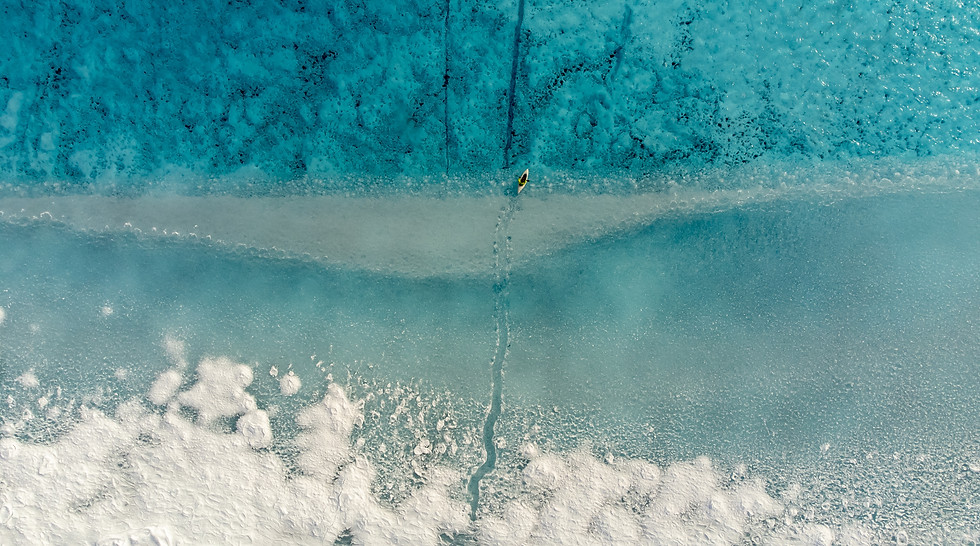
The deep blue of the supraglacial lakes on the Greenland ice sheet, where we carried out our mission—and therefore filmed the documentary.
Is there anything else about your film or experience that you would like to share?
The importance of educating younger generations through inspiration.